.png)
Quick Summary
AI isn't making Global Capability Centers (GCCs) less relevant, it's making them more valuable. As demand for AI, cloud, and data talent accelerates, the companies pulling ahead are investing in execution, not just technology.
Key Takeaways
- The most successful GCCs are measured by speed-to-value, AI adoption, talent quality, and business outcomes rather than headcount.
- Companies investing in AI still need skilled professionals to govern models, manage data, integrate enterprise systems, and redesign business processes.
- BOT Consulting and Tercera Advisory share a vision that AI-enabled Global Capability Centers will become a key competitive advantage for high-growth technology companies.
Why the "services is over in the AI era" narrative misses the bigger opportunity and how we're building towards a future where AI, talent, and global capability centers become a competitive advantage.
India today has more than 480 mid-market capability centers, about a third of them set up in just the last two years. As NASSCOM's president put it, the next wave "will not come from size, but from speed, specialisation, and strategic influence."
That cuts against the loudest story in tech right now, that AI is here, so the global team is the first thing to disappear. The companies actually putting money to work tell a different story. They aren't shrinking their teams; they're redesigning them into operating platforms for AI-driven growth. Not back offices built to cut cost, but where AI gets deployed, governed, and turned into real business outcomes.
For the last two years, the reflex answer to every market question was to call yourself “AI-powered.” That label has stopped carrying weight. Everyone has an AI strategy now, which means the words no longer separate anyone. Buyers have moved past the adjective. What they are buying is the outcome: speed to value, quality of talent, real contribution to growth. The firms that win the next phase will not be the ones that claim AI the loudest. They will be the ones that can show what it produced.
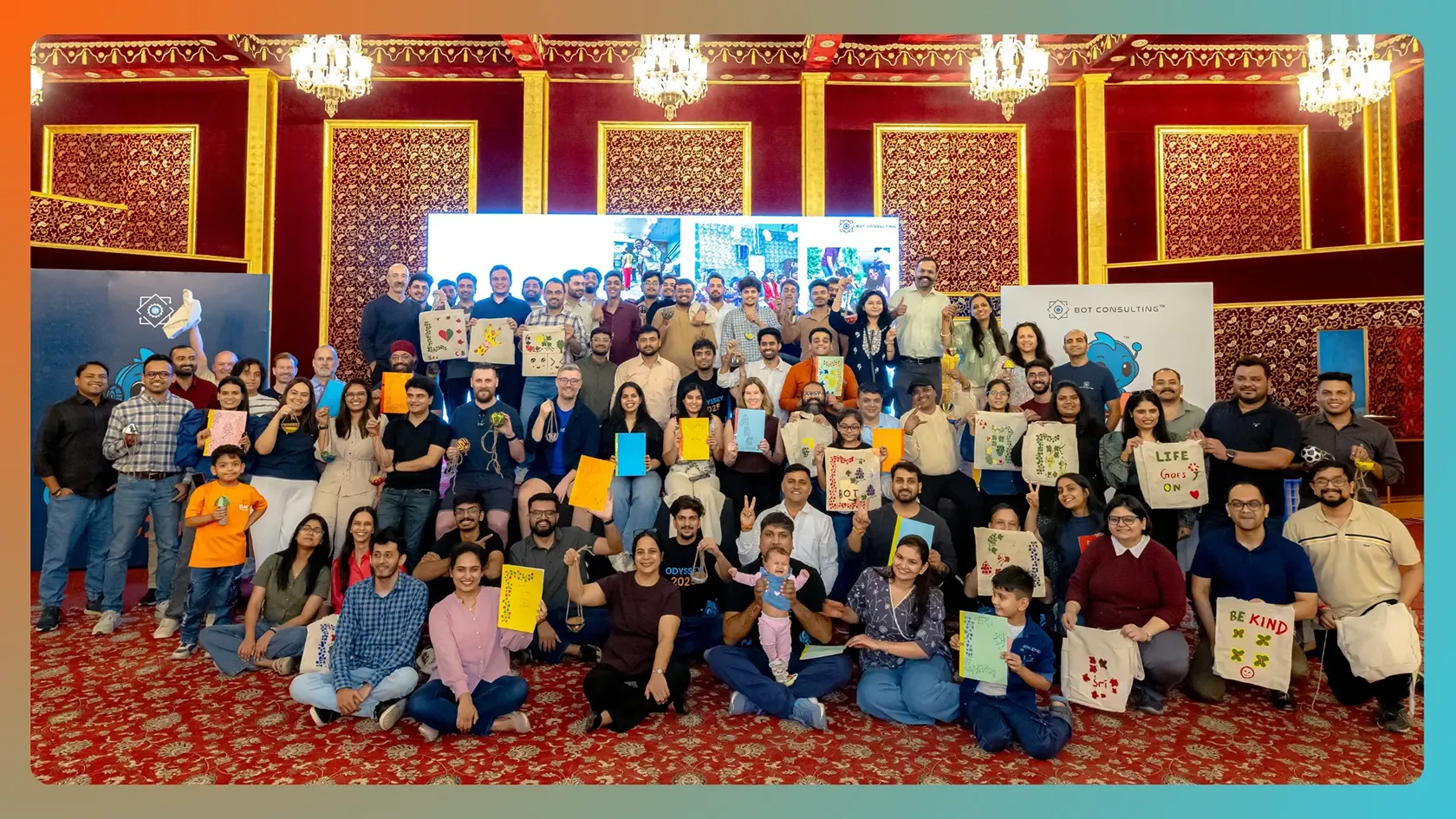
That is the future we are building for. To help accelerate that vision, BOT is partnering with Tercera Advisory, a team of seasoned technology services operators, founders, and growth advisors who have helped scale some of the industry's most successful firms. Together, we're building for the next wave of technology services, where AI, talent, and global capability centers converge to create lasting competitive advantage.
.png)
Ignore the Headlines. Watch the Market.
Most of the disruption talk is aimed at one narrow kind of work: transactional, low-skill, handled ticket by ticket. That work was always going to be automated, and it is not where the market is heading.
Capability centers are no longer built only for cost arbitrage. The best of them now own engineering, AI operations, customer workflows, and product development at scale. McKinsey describes GCCs as critical innovation hubs shaping the future of business, and frames AI as a tailwind rather than a headwind. BCG puts it more plainly: GCCs have always been good at running the engine room; the best ones are now learning to steer the ship.
The pattern underneath all of it is simple. AI is not ending the GCC model. It is separating the centers built for cost from the ones built for outcomes.
What the leaders are saying:
“You don’t just need talent, you need an operating system that brings consistency, best practices, and execution into how teams actually work.” — Michelle Swan, CMO, Tercera
“Very few firms have actually built, scaled, and successfully transferred global teams multiple times — and that kind of experience shows up in speed to value. That’s what really matters.”— Chris Barbin, CEO, Tercera
BOT brings the operating capability. Tercera brings the market perspective. Together, we close the distance between where the market is heading and what it takes to execute there.
The New Rules for GCCs and How Odyssey Delivers Them
The market has quietly rewritten what a good capability center is measured on. The old scorecard counted headcount, cost per seat, and ticket volume. The new one looks at speed to value, how deeply AI is adopted in the actual work, and how much the team contributes to enterprise growth.
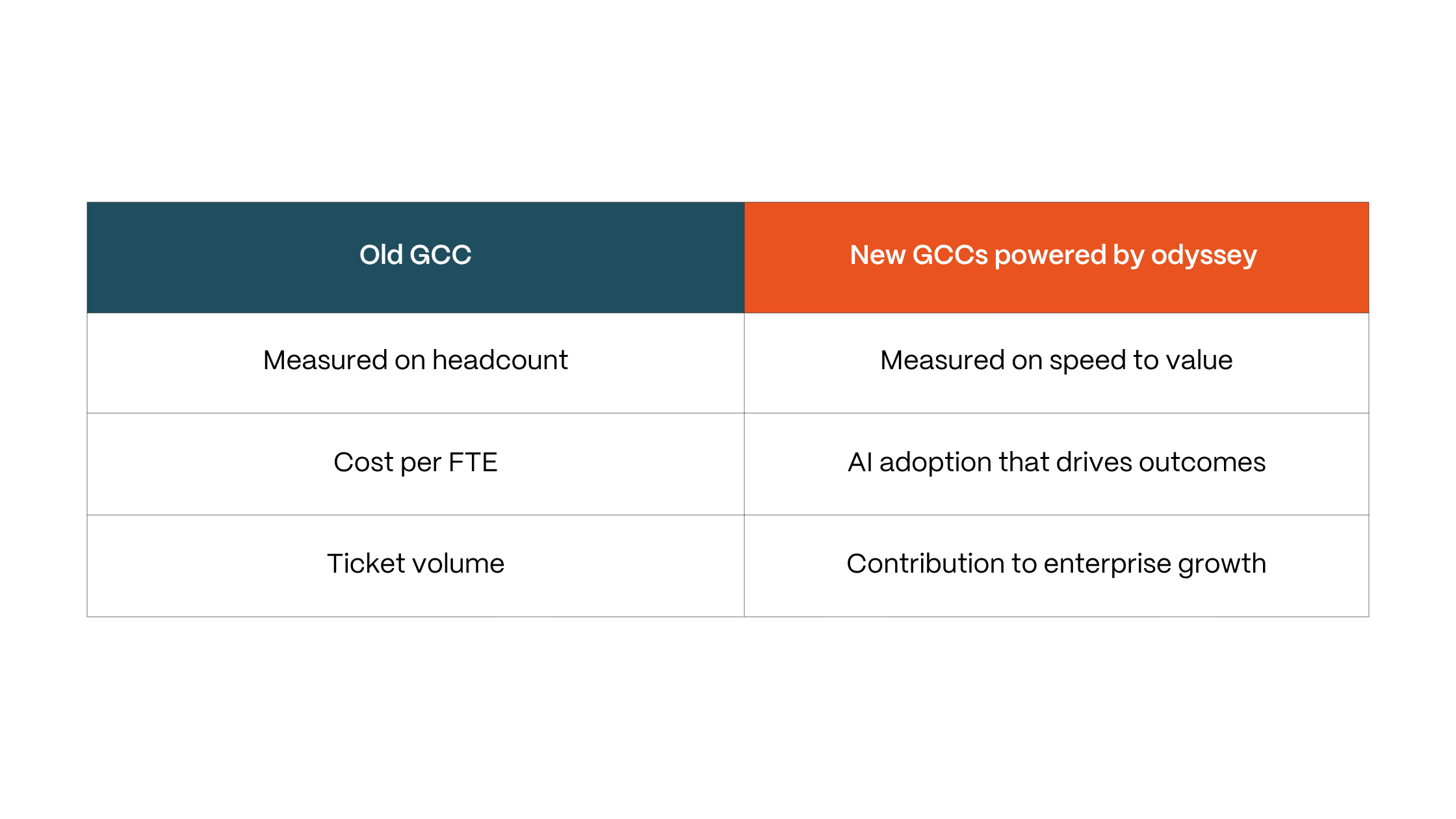
That shift is easy to put on a slide and hard to deliver. Odyssey is how we deliver it. It is BOT’s operating system for building and running capability centers, and it maps directly onto the new scorecard:
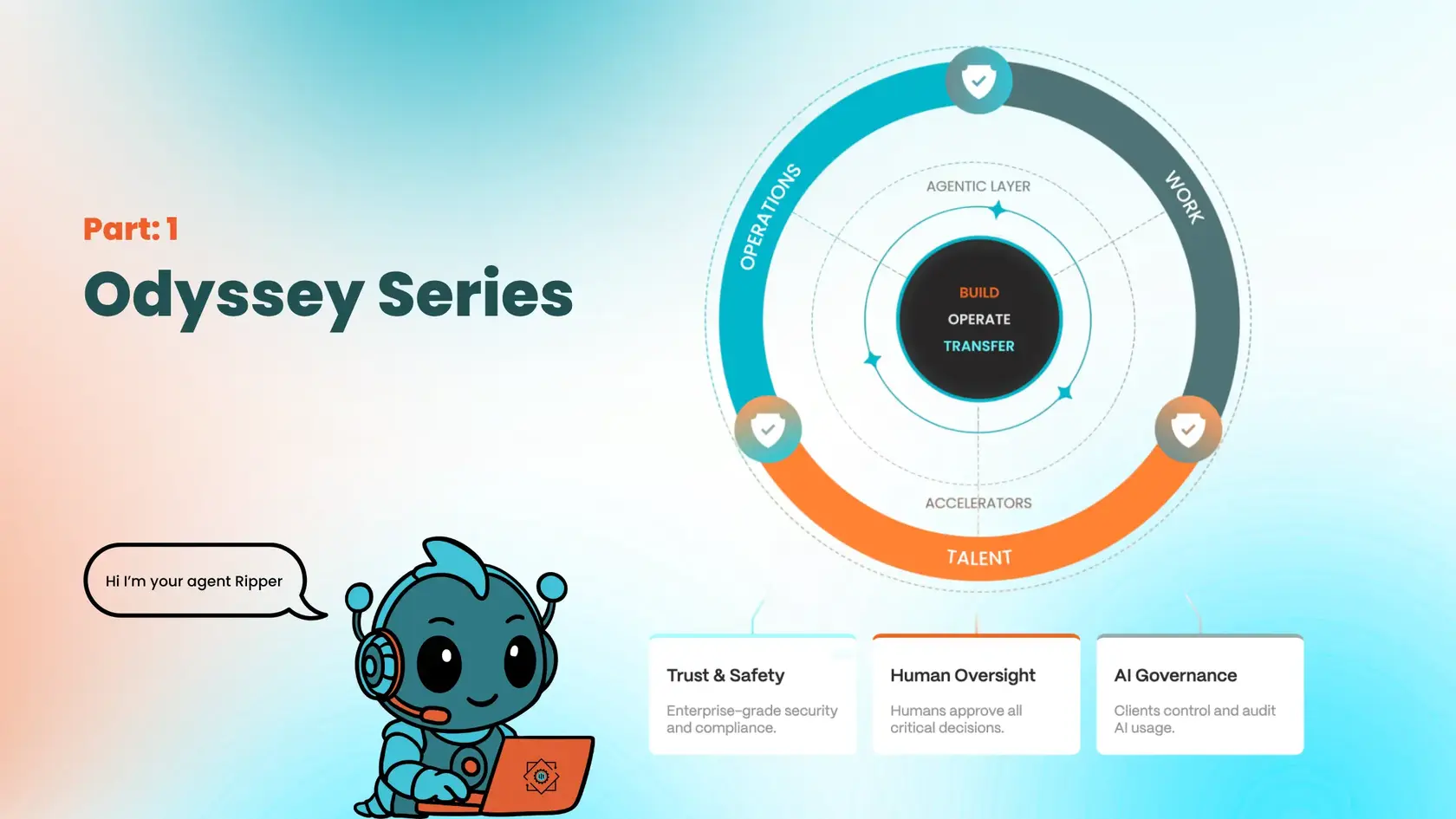
- Speed to value: a Build–Operate–Transfer model and pre-built accelerators stand up a center in as little as six weeks, not several quarters.
- AI adoption that counts: an agentic layer embeds AI into how work actually gets done — with human oversight, governance, and auditability built in rather than bolted on.
- Contribution to growth: we run BOT itself on Odyssey — customer zero — which is how the same model has supported teams like Hakkoda (now part of IBM) and Bettera.
The proof is in the operating numbers, not the pitch: one GCC launched in six weeks became eight running in parallel, all out of Jaipur, with $1.2 billion in value created behind the method.
Read more about Odyssey, from here.
The Bottleneck Isn’t Technology? It’s Execution.
The ISG 2025 Global Capability Center Study found the biggest barriers to AI success in GCCs were talent availability, change management, and business integration — not the technology itself. McKinsey estimates that more than 85% of the AI opportunity sits in genuine transformation, redesigning how work gets done, rather than in automating isolated tasks.
That is the real divide, and it has little to do with which model you picked. It comes down to whether there is an operating system underneath the AI that turns it into outcomes. BCG research suggests only about 8% of GCCs operate at an advanced level today. I do not read that as a crisis. I read it as how much room there still is to lead.
Everyone has an AI strategy. Few have an operating system. There is no artificial intelligence without process intelligence and that is exactly where most organizations get stuck.
What Comes Next
Every leader with a global team is about to face the same decision: does it stay a delivery engine, or become an operating platform for growth? We are building for the second. With Tercera alongside us.
If you are thinking the same way, it is time to start that conversation.