.png)
Quick Summary
Platforms like Salesforce and ServiceNow are going agentic while SAP holds its data layer closed — a divergence that will reshape services firms faster than any model release. The real money isn't in the AI model layer anymore; it's in implementation, proven by Anthropic, Blackstone, Hellman & Friedman, and Goldman Sachs backing Ode with $1.5B on exactly that bet. For SI and GCC leaders, the real choice isn't build vs. buy AI — it's whether your operating model is ready to run agentically before the pricing shift forces the question.
Key Takeaways
- AI implementation vs. AI models: the money isn't in the model layer anymore it's in who can put AI to work inside a company, and a GCC is how you build that muscle.
- Build vs. buy AI for GCC: the real choice isn't whether to build the operating model yourself or run on one that's already agentic.
- Agentic GCC operating model: speed to launch (8–12 weeks) and demand-led scaling matter more than headcount — the moat is the system, not the number of people in it.
SAP is doing one thing. Salesforce and ServiceNow are doing the opposite. If you run a services firm in any of these ecosystems, that one divergence will shape your next three years more than any model release will.
SAP is restricting agentic access to its data and process layer — protecting the process as the moat. Salesforce and ServiceNow are going the other way: headless, full agentic access, handing the keys to whoever can orchestrate them. Two philosophies, out in the open. And a split at the platform layer never stays at the platform layer. It travels — down the stack, into the partner ecosystem, and eventually onto your P&L.
I watch this from a specific seat. I build and scale Global Capability Centers for systems integrators across Salesforce, AWS, ServiceNow and Snowflake. Eight of them, running at once. From that seat, the consolidation everyone is debating in the abstract is not abstract. It's in my inbox.
The value already left the model
Here's the pattern. AI-native companies — Anthropic, OpenAI, Nvidia — are compounding value at a speed the software industry has never seen. When value concentrates that fast at the model layer, the layers above it consolidate to stay relevant. That's what a Salesforce-and-Anthropic alignment actually signals: the enterprise AI race won't be won at the model layer, it'll be won at the customer-data layer — and whoever owns the distribution to that data owns the leverage. When the platform moves, the partner ecosystem gets re-priced. Not eventually. Fast.
And I can already see it reaching the partners I work with. The pure-play cloud- and data-tech SIs have quietly concluded that data is the technology now — and they're being asked to pick a camp at the model layer to prove it. OpenAI or Anthropic. Increasingly Google alongside them. Palantir stays strikingly closed to most of them, so the ones building real agentic capability are doing it on the open frontier labs. That's what consolidation looks like from inside the ecosystem: not a merger headline, but a partner realizing their innovation roadmap now rides on an allegiance they didn't have to make eighteen months ago.
And the smart money has already placed its bet on where this ends. In July, Anthropic, Blackstone, Hellman & Friedman and Goldman Sachs put $1.5 billion into Ode — a venture whose whole premise is deploying AI engineers inside enterprises, because, in its CEO's words, "model selection matters, but it's not where the majority of calories are spent." Read that again. The people closest to the models are telling you the value isn't in the model. It's in the implementation. The trillion-dollar business everyone's chasing isn't the next frontier model — it's who can actually put it to work inside a company.That's the whole game moving to your side of the table.
Your operating model didn't get the memo
So here's the question I'd put to any SI CEO reading this. When your platform goes headless and agentic, your delivery surface changes overnight. Does your operating model change with it — or does it stay exactly where it was?
For most firms, honestly, it stays. I've been comparing notes with Lori Williams, who's built a maturity model that scores a services firm from Explore to Native on how deeply AI actually runs through the business — go-to-market, offerings, delivery, operations, people. Most of the SIs I work with sit at Pilot. Structured experiments, a few copilots, real intent — but AI hasn't rewired how they sell, deliver, or price. Consolidation doesn't care where you sit. It forces you to Scale on a timeline you didn't choose.
And the economics are unforgiving. Bain estimates that services firms operating business-as-usual could watch revenues erode by 30% or more as AI automates the work — on the way to a 45–50% enterprise-value loss over five years once margin compression is added. Sit with what that means if you bill by the hour: AI compresses delivery by 30 to 50%, so it mechanically shrinks your own invoice. You hand the productivity straight back to the client as a smaller bill. The firms moving the other way are already proving the alternative — one re-priced around fixed-fee engagements and lifted revenue per delivery FTE by more than 40% in eight months. Tooling was never the hard part. The pricing model is.
The SI that waits eighteen months wakes up to find time-and-materials quietly replaced by outcome-based pricing it never designed for. Build-and-test cycles that used to take months now run in days — and the competitors running them that way are winning the work. New roles it doesn't have: forward-deployment engineers driving business-workflow change, people who own adoption instead of assuming it, a governance function that turns organizational knowledge into an asset. None of that is bought in a quarter. It's built into how a firm operates — or it isn't there when the quarter arrives.
Build versus buy is the wrong question
Everyone frames this as build versus buy — should we build our own AI platform or buy one? Will Sun at Auctor put it better than I've heard anyone put it: the real question is whether you want to become a software company that also does services, or stay a services firm that uses AI. The same logic applies one level up, to the GCC. Do you want to become a company that operates a Global Capability Center — the entity, the talent engine, the delivery standards, the governance — or do you want to run an agentic GCC on an operating system already built for it?
I know which side of that I'd take, because I've watched the alternative up close. When I first sat down with the leadership of a fast-growing Salesforce SI, the CEO was skeptical — politely, but genuinely. The playbook his investors wanted was the familiar one: stand up a GCC, lift the margin. What he cared about was harder to put on a spreadsheet — protecting the culture and the innovation edge that made the firm worth backing in the first place. He'd heard the offshoring horror stories: entities that take months to stand up and stay a compliance headache forever, no real leadership on the ground, quality that drifts the moment it crosses a time zone. His honest fear wasn't that it would fail. It was that it would distract him — that he'd spend a year on paperwork and attrition instead of creating value for his stakeholders.
So we didn't lead with the entity. We led with talent. One of the first people we hired for him was a young innovation leader who thought agentically by default, and in his second week he said something that stuck with me: in the AI era, Agile is the new waterfall. I didn't buy it. Two weeks later he'd proved me wrong — a working agent, live and running a real, revenue-critical workflow, the kind of build the old playbook would have booked as a quarter-long project, standing up in a fortnight. The wall this firm feared was never engineering. It was standards — how work gets estimated, assigned and delivered across time zones at the same quality and three times the speed — plus change management, and holding talent through their notice periods so the ramp didn't stall. We took them past a hundred consultants: laterals billable from Day 0, and fresh graduates who became the culture's fiercest carriers. The muscle they were missing was operational — and operational muscle is the slowest kind to build alone.
We made ourselves the first hard problem
Here's the shift underneath all of it. For three decades an SI's moat was people — how many, how skilled, how cheap. That's ending. The new moat is institutionalized skill: finding the handful of skills behind a job that repeats, building the workflow that runs on them, and owning it as reusable capability so it lives in the system, not in the person who happened to know it. When skill becomes an asset the firm owns, delivery moves to outcomes, and margin stops leaking every time a good engineer resigns.
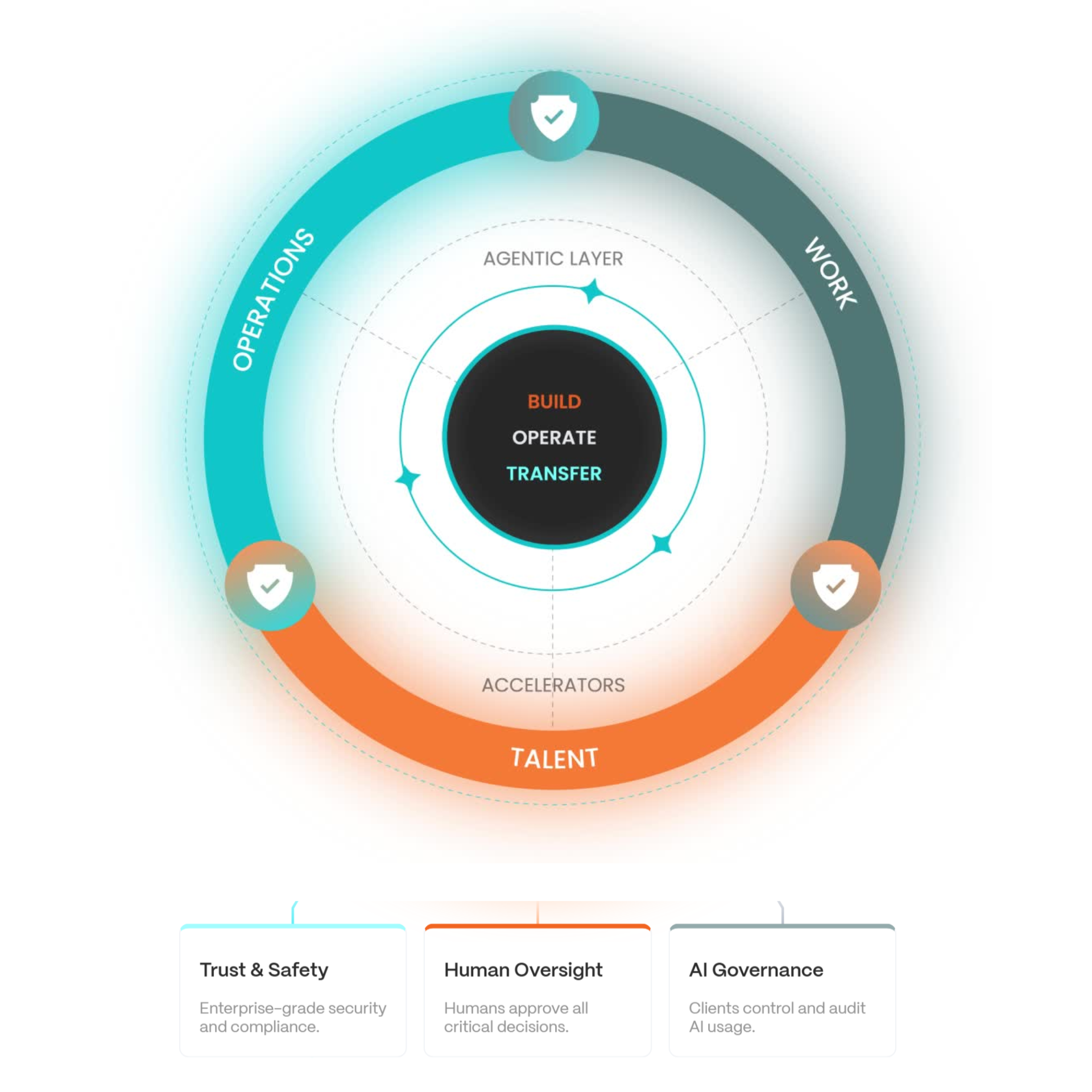
I know that works because we made ourselves the first hard problem. Our operating system — Odyssey — has run our GCCs for over a year, and its agentic layer isn't slideware: inside our own house, talent acquisition, financial modeling, sales analysis and document governance already run as agentic workflows. That's what being Customer Zero means. In the engagement where we've pushed it hardest, role adoption is running up to 70% faster and the cost of innovation has roughly halved. I'll show the whole thing live at our Annual Partner Summit in October.
Rewire, or compress
So here's your choice. Keep estimating and delivering on people-and-role math — or rewire your methodology, tooling and estimation to run agentic. Because bolting AI onto broken process, fragmented knowledge and untrustworthy data doesn't fix anything. It just automates your inefficiency at scale.
The consolidation isn't a prediction I'm making. It's a pattern already sitting in my inbox. The only open question is who rewires in time to compound — and who waits, and compresses.
I'd rather show you than tell you. That's what October is for.